
Creartful AIFAQ
Questions, answered.
What people ask us before the discovery call, grouped by subject. If yours is not here, ask it on the call.
Plans and pricing.
Why are there no prices on the site?
A ten-page local site and a catalog of thousands of products are different climbs. After the discovery call you get a written plan with scope, phases, timeline and an estimate tied to it.
Which plan should we choose?
If you want to run the workspace yourself, Build. If you want us to carry the monthly work, Run. If you have more than one site, store or brand, Scale.
What counts as a task?
One piece of work with one result you can review: a collection of descriptions refreshed, one campaign built, one page added. The Plans page lists the task types.
Can we change plans later?
Yes. You can move up at the start of any cycle. Moving down is agreed on a call and follows your term.
How do we stop or pause?
The terms for pausing or ending a plan are set out in your written plan, before anything starts, so there are no surprises later.
The workspace.
What is a client AI workspace?
A dedicated Claude project for your business, holding your brand rules and product details, connected to your tools through MCP so marketing tasks can be drafted in one place.
Do we need to be technical to use it?
No. On every plan we do the work in it for you, and walk your team through it so they can use it too.
Why are AI drafts not the same every time?
AI models write a fresh draft each time they are asked. That is why the workspace holds written brand rules, and why a person reviews every output we ship.
Is this the same as a chatbot on our site?
No. The workspace is a working space for your marketing, used by us and your team. It does not talk to your customers.
Human belay.
What is human belay?
Our term for the person holding the rope on every AI-assisted step. We review, reprompt and steer each output before it reaches your site or your customers.
Who does the work? Is it outsourced?
The work is set up, run and reviewed by people at Creartful, the studio behind Creartful AI.
What does a reviewer check?
Facts against your live data, prices and links, claims against your brand rules, and tone. If a draft misses, it is reprompted or rewritten before it goes anywhere.
Do we still approve things?
For anything that changes your site, store or list, your written plan names an approver on your side and says what they sign off.
Data and access.
Do you need our passwords?
No. Access is granted from your own accounts, through each tool’s own permission screens, and you can remove it there at any time.
Is our data used to train AI models?
Client workspaces run on Anthropic’s commercial plans, where inputs and outputs are not used to train models by default. The Your data page covers the rest.
Can the workspace change our site on its own?
Not on the work we run. Changes are prepared as drafts and applied only after review.
Who owns what the workspace drafts?
The work we deliver for you is yours. Ownership of the site, the workspace and each account is set out in your written plan.
Search and AI answers.
What is AEO?
Answer engine optimization: structuring your pages so AI answer engines can read what you sell, where you sell it and what it costs, the way search engines read a well-built site.
Is AEO different from SEO?
It builds on SEO. Clear pages, honest headings and structured data serve both. AEO adds answer-first copy and checks of how AI tools describe your business.
Can you guarantee rankings or AI citations?
No, and be wary of anyone who does. Search engines and AI models change how they choose sources. We build the site so it is easy to read and easy to cite, and we report what changed.
What does agentic commerce readiness mean?
Organizing a store so AI shopping agents can read products, pricing and availability accurately, not just human visitors. It is part of the Expedition plan.
Which data does the SEO and AEO work use?
Search Console for queries and clicks, GA4 for traffic and AI referral visits, Merchant Center for product feeds, and your Business Profile for local details, read together in your workspace.
Do you connect our CRM and email platform too?
Yes, where a connector exists or one can be built. HubSpot, Salesforce, Klaviyo and Attentive publish their own. The Connectors page shows where each one stands today.
Glossary
The route, in words.
The terms we use on this site and in your plan, defined once.
- Origin Point
- The discovery call. One conversation about your site, your tools and the work that repeats.
- Human belay
- The person holding the rope on every AI-assisted step: reviewing, reprompting and signing off.
- Claude project
- The workspace set up for your business, holding your brand rules, files and live connections.
- MCP
- The Model Context Protocol, an open standard for linking an AI model to the software you already use.
- Connector
- One MCP link between your Claude project and one of your tools, with its own access and its own tests.
- AEO
- Answer engine optimization. Pages built so AI answer engines can read and cite them accurately.
- Changelog
- The short written report after every cycle: what changed and what is next.
- Summit
- The engine working as one: the site, the workspace and the people reviewing it.
Next steps
Three ways in.
Book a call to talk it through, ask the help desk a question, or sign in if you are already a client.
Origin Point
Book a discovery call.
One conversation about your site, your tools and the work that repeats.
Book a callHelp desk
Ask a question.
Search the answers, or send a request and a person replies.
Open the help deskClients
Sign in to your portal.
Your changelog, approvals, reports and access.
Client sign-in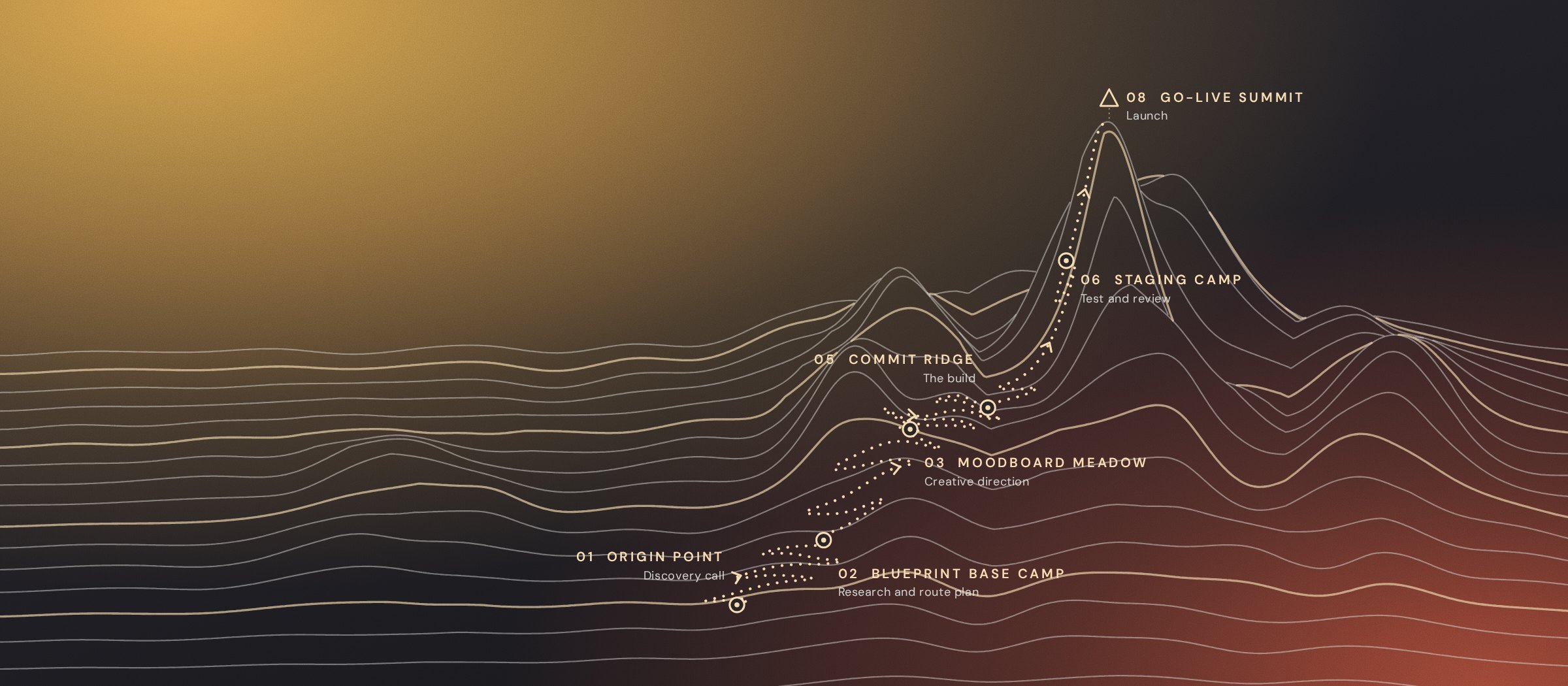
Still have a question?
Start at the Origin Point.
Ask it on the discovery call. One conversation about your site, your tools and the work that repeats.